

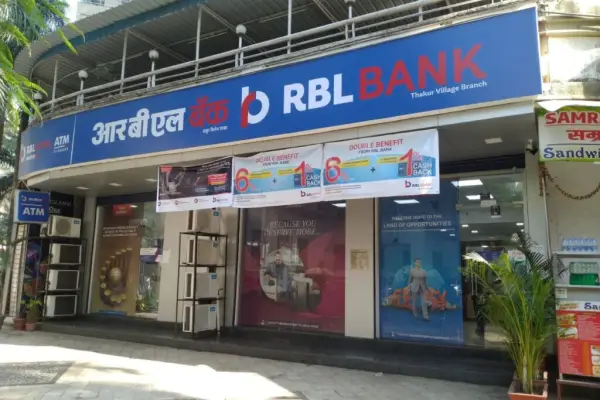
In a single week, RBL Bank went from a quietly recovering mid-tier lender to the centre of the largest foreign direct investment in the history of India's financial services sector. The Finance Ministry has cleared Dubai-based Emirates NBD's acquisition of up to 74% stake in RBL Bank — a ₹26,853 crore deal that is rewriting the bank's future. Pair that with a 234% quarterly profit jump, falling NPAs, and a 52-week high on the stock, and the full picture of RBL Bank in May 2026 is one of an institution at a genuine inflection point.
Mumbai | May 16, 2026 — There are weeks in a company's life that simply stand apart from everything that came before. For RBL Bank, this was that week.
On May 14, 2026 one day before Prime Minister Narendra Modi departed for his official visit to the UAE — India's Ministry of Finance sent a letter through the Department of Financial Services that quietly unlocked what could be the most consequential transaction in the history of Indian private banking. It cleared Dubai-based Emirates NBD Bank to acquire between 49% and up to 74% of RBL Bank's total paid-up equity share capital.
The deal, valued at approximately $3 billion (₹26,853 crore), is not just a capital infusion. It is the largest foreign direct investment ever made in India's financial services sector full stop. And it arrives at a moment when RBL Bank itself is posting its best quarterly numbers in years.
How the Deal Was Built: Seven Months of Regulatory Dominoes
The story actually began in October 2025. On October 18, RBL Bank and Emirates NBD announced a formal investment agreement under which the UAE's second-largest banking institution 56% owned by the Dubai government through the Investment Corporation of Dubai would acquire a primary stake of approximately 60% through a preferential issue of 959 million new equity shares at a price of ₹280 per share.
The terms also included a mandatory open offer for an additional 26% from public shareholders, consistent with SEBI's takeover code. The ambition was clear from day one: Emirates NBD would not just be a financial investor. It would be the controlling parent, and RBL Bank would be reclassified as a foreign bank in subsidiary mode.
What followed was a regulatory relay race. In November 2025, RBL Bank's shareholders gave their overwhelming endorsement 99.9% voted in favour of the amalgamation and 98.8% approved the preferential issue at an extraordinary general meeting. In January 2026, the Competition Commission of India (CCI) cleared the deal. In April, the Reserve Bank of India gave its own approval for Emirates NBD to acquire up to 74%. In May, the RBI separately approved amendments to RBL Bank's Articles of Association to formalise Emirates NBD's director nomination rights. And on May 14, the Finance Ministry completed the final sovereign clearance.
Every major hurdle has now been crossed. Emirates NBD Group Chairman Ahmed bin Saeed Al Maktoum called the approvals a reflection of strong bilateral ties between India and the UAE. The deal includes the proposed merger of Emirates NBD's existing Indian branches in Mumbai, Gurugram, and Chennai into RBL Bank effectively giving the combined entity a more robust, unified balance sheet from day one.
What ₹26,853 Crore Actually Means for RBL Bank
For a bank with a net worth of approximately ₹15,610 crore at the time the deal was announced, the incoming capital injection is transformative in scale. Post-completion, RBL Bank's net worth is projected to climb to somewhere in the ₹42,000–44,500 crore range nearly tripling its equity buffer and catapulting its Tier-1 capital ratio significantly higher.
That capital firepower matters in practical banking terms. It gives RBL Bank the headroom to grow its loan book aggressively without hitting capital adequacy constraints, expand its digital banking infrastructure, deepen corporate lending relationships, and build a wealth management business that can genuinely compete with larger private sector peers.
There is also the remittance dimension. The UAE accounts for nearly half of the $38.7 billion that India receives in remittances from Gulf countries annually. Emirates NBD, with its deep roots in that corridor, brings a natural customer acquisition and cross-border transaction pipeline that RBL Bank simply could not have built organically.
Q4 FY26 Results: The Numbers Behind the Story
Alongside the regulatory theatre, RBL Bank delivered its Q4 FY26 results in late April and they were sharp by any measure.
Standalone net profit for the January-March 2026 quarter came in at ₹230 crore, a 234% jump from just ₹69 crore in the same quarter a year earlier. Sequentially, that was a further 7% increase from ₹214 crore in Q3 FY26. For the full financial year FY26, the bank's net profit rose 18% to ₹822 crore from ₹695 crore in FY25.
Net interest income for Q4 grew 7% year-on-year to ₹1,671 crore the highest quarterly NII the bank has posted in recent history. Other income rose 7% to ₹1,069 crore, with core fee income growing 9% to ₹1,057 crore. Operating profit hit ₹955 crore, up 11% year-on-year. The cost-to-income ratio improved to 65.1%, down from 66.3% in Q3.
The loan book expanded meaningfully. Net advances rose 23% year-on-year to ₹1,14,232 crore, with secured retail advances the bank's deliberate strategic pivot surging 36% year-on-year to ₹40,207 crore. Total deposits grew 25% year-on-year to ₹1,39,018 crore, while CASA deposits climbed 23% to ₹46,723 crore, taking the CASA ratio to 33.6%. Total business crossed the ₹2,50,000 crore mark for the first time, up 24% year-on-year.
Provisions fell 14% year-on-year to ₹639 crore a meaningful reduction that directly boosted the bottom line.
Asset Quality: The Turnaround Is Genuine
Perhaps the most impressive part of the Q4 story is what happened to RBL Bank's asset quality. The gross NPA ratio improved sharply to 1.45% from 2.60% a year earlier and 1.88% in the preceding quarter the lowest GNPA reading the bank has posted in several years. Net NPA stood at 0.39%. The provision coverage ratio, including technical write-offs, reached 94.91%.
Management has indicated that the worst of the stress in the microfinance segment is behind the bank, with early-bucket repayment efficiency in the JLG (Joint Liability Group) book running at 99.7% in March 2026. The credit card book remains a near-term watch item, with management expecting slippages through H1 FY27 before improvement kicks in from H2 onwards.
Return on assets at 0.43% and return on equity at 4.17% remain below industry averages a reminder that while the recovery is real, the bank is still rebuilding from a depressed base rather than operating at full efficiency. These ratios will be the key metrics to watch through FY27 as the Emirates NBD capital lands.
The Board's Signal: A ₹1 Dividend
At its April 25 board meeting, RBL Bank's directors recommended a dividend of ₹1 per equity share (face value ₹10) for FY26 the first time in recent memory the bank has been in a position to make a dividend recommendation with confidence. While the absolute payout is modest, the gesture carries symbolic weight: this is a management team signaling that it believes the worst is clearly in the rearview mirror.
The bank also crossed 603 branches after adding 23 branches in Q4 alone, and management said branch-led asset sourcing across gold loans, home loans, working capital, and secured business loans is being prioritized as the next engine of retail growth.
The Stock: From ₹188 to ₹350 in Twelve Months
The market has been paying close attention to every development. RBL Bank shares touched a fresh 52-week high of ₹349.75 on May 7, 2026 a remarkable 73% gain from the 52-week low of ₹188.10 touched less than a year ago. When RBI first signaled approval for the Emirates NBD deal, the stock jumped nearly 6% in a single session. When Q4 results landed, it added another 2.89%.
At current levels around ₹313–320, the stock is still trading below the Emirates NBD preferential allotment price of ₹280 wait, actually above it which sets an interesting pricing dynamic in the market. Analysts who cover RBL Bank have upgraded it to Buy citing the capital infusion as a valuation re-rating trigger. The bank's market capitalisation stands at approximately ₹19,376 crore a number that will look very different once ₹26,853 crore of fresh equity is in the door.
Geopolitical Dividend: The India-UAE Timing Is No Coincidence
The timing of the Finance Ministry's approval signed the day before PM Modi's departure for his UAE visit was not accidental. India and the UAE have been deepening economic ties systematically through the Comprehensive Economic Partnership Agreement (CEPA) and their joint anchoring of the India-Middle East-Europe Economic Corridor (IMEC). The RBL Bank-Emirates NBD deal is, in many ways, a living demonstration of that bilateral ambition translated into hard financial capital.
For India's banking sector, it also sets a precedent: a major global institution deploying $3 billion for a controlling stake in an Indian private bank signals that the regulatory environment is now investor-friendly enough to absorb large, complex FDI transactions. That is a confidence signal that extends well beyond RBL Bank itself.
What Comes Next
The final RBI clearance for the deal's completion remains outstanding. Once that arrives, the preferential allotment will proceed, the Emirates NBD India branch merger will be executed, and RBL Bank will formally transition into a foreign-controlled subsidiary a unique structure in India's private banking landscape.
For investors, the question is whether the current stock price has fully priced in the capital upgrade or whether the execution of FY27 growth targets with three times the equity capital still represents upside. Management's own guidance points to stable margins in Q1 FY27, improvement from Q2, and a return to stronger profitability metrics as the capital-heavy balance sheet begins generating its full return.
RBL Bank is not the same institution it was twelve months ago. Whether it will look like a transformed bank twelve months from now that story is still being written.
Disclaimer: This article is for informational and educational purposes only and does not constitute investment advice. Readers are encouraged to consult a registered financial advisor before making investment decisions.