
Hindustan Copper just delivered its most profitable year ever net profit nearly doubled, quarterly earnings surged 133%, and production hit a fresh peak. But the bigger story is what comes next: a ₹7,188 crore expansion plan, a strategic alliance with the world's largest copper miner, and ambitions to triple ore capacity by 2030. Here is the full picture, number by number and move by move.
Kolkata / New Delhi | May 15, 2026 --There are not many companies in India that can claim to own every single operating copper ore mining lease in the country. Hindustan Copper Limited holds that distinction alone and on Thursday evening, it backed that monopoly status with the strongest set of annual numbers it has ever produced.
The Kolkata-headquartered PSU, operating under the Ministry of Mines, posted a standalone net profit of ₹920.67 crore for the financial year ended March 2026 nearly double the ₹468.53 crore it earned in FY25. Revenue from operations climbed to ₹3,077.92 crore from ₹2,070.96 crore a jump of close to 49 percent in a single year. For a company that spent much of the last decade struggling with slow mine ramp-ups, cost overruns, and governance scrutiny, these are not small numbers. This is a structural shift.
But the results themselves are only the beginning of the story.
Q4 FY26: The Quarter That Delivered
The final quarter of FY26 was where Hindustan Copper truly flexed its operational muscle. Consolidated net profit for January-March 2026 came in at ₹444.06 crore a 133 percent year-on-year jump from ₹190.54 crore in Q4 FY25. That is not a modest beat; that is a transformation quarter.
Revenue from operations for Q4 stood at ₹1,156.08 crore, up 58 percent from ₹731.40 crore in the year-ago period. Total income for the quarter reached ₹1,188.76 crore. Earnings per share for the quarter surged to ₹4.59 up from just ₹1.62 in Q3 FY26 and ₹1.97 in Q4 FY25. The sequential leap alone profit more than tripling from Q3's ₹156.31 crore tells you something important: the second half of FY26 saw Hindustan Copper firing on all cylinders, driven by stronger copper realizations, better mine output, and improved operational throughput.
Total expenses for Q4 stood at ₹596.55 crore, up from ₹397.04 crore in Q3 a reflection of higher activity levels rather than cost inefficiency.
Production: A New Peak on the Chart
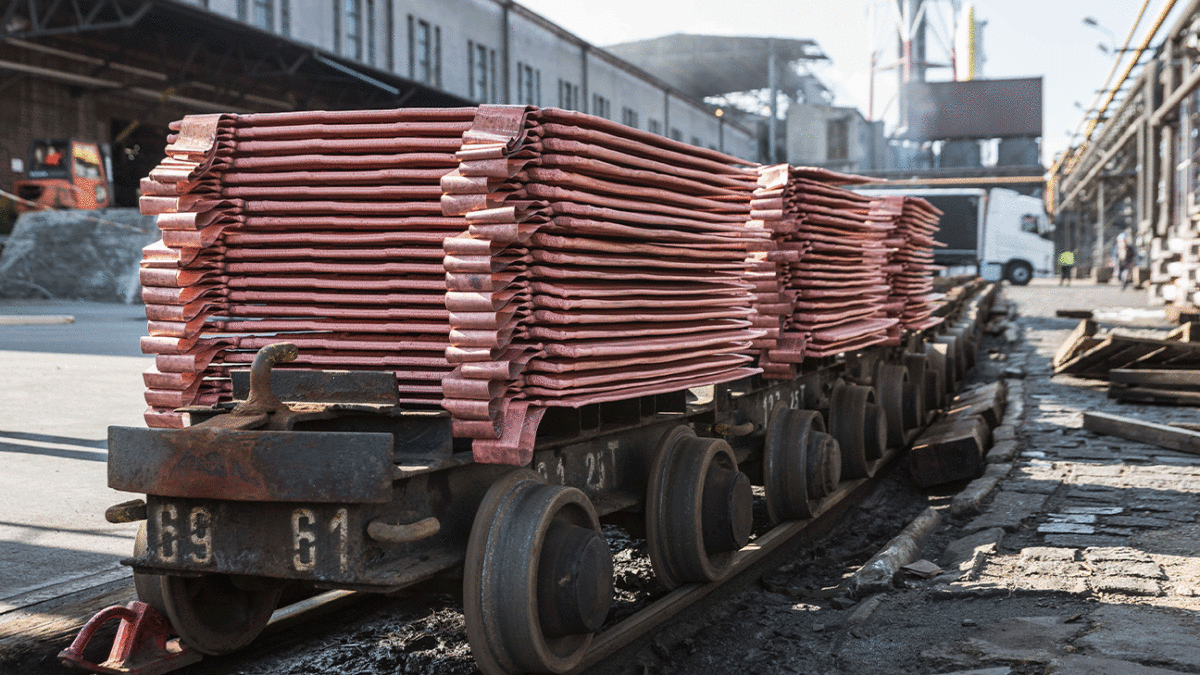
Behind those financials is a production story that management has been building brick by brick over several years. Hindustan Copper reported record copper production of 27,421 tonnes in FY26 the highest output in the company's history.
The Malanjkhand Copper Project (MCP) in Madhya Pradesh, the company's flagship asset, drove much of this momentum. Having completed its transition from open-cast to underground mining a technically demanding shift Malanjkhand produced over 4.21 million tonnes of ore in FY26. The mine now operates with one of India's first large-scale paste fill plants, a technology that improves underground safety and reduces environmental disruption simultaneously.
Operations also resumed at Kendadih Copper Mine in Jharkhand, where underground mining commenced in January 2026. Job contracts exceeding ₹1,400 crore have been awarded to accelerate development work across multiple mine sites, and a new copper block was acquired in Sidhi, Madhya Pradesh through a competitive auction lease.
Dividend: Shareholders Get Paid
The board, at its meeting on May 15, recommended a final dividend of ₹1.86 per equity share (face value ₹5) for FY26, subject to shareholder approval at the forthcoming AGM. This comes on top of an interim dividend of ₹1 per share paid in March 2026, and an earlier interim dividend of ₹1.46 per share paid in September 2025. Taken together, shareholders received a total payout of ₹4.32 per share for the full year a meaningful return, particularly for income-oriented investors in the PSU space.
Capital Raise: QIP and NCD Both in Play
Alongside the results, the board approved two significant fundraising proposals. First, it cleared a Qualified Institutional Placement (QIP) of up to 9,69,76,680 equity shares with a face value of ₹5 each, to be executed in one or more tranches. Second, it approved the issuance of secured or unsecured Non-Convertible Debentures or bonds via private placement, up to ₹500 crore.
The message is clear: Hindustan Copper needs fresh capital and it needs it at scale to fund the expansion ambitions laid out in its Vision 2030 roadmap. The QIP, when it goes through, will dilute existing shareholders marginally, but the proceeds are expected to finance capacity additions rather than service debt. The company is described as nearly debt-free at the corporate level, which gives it a clean slate for this next phase of spending.
Vision 2030: The ₹7,188 Crore Blueprint
Nothing captures Hindustan Copper's ambition right now like its Vision 2030 plan, unveiled in April 2026 and reviewed by Deloitte Touche Tohmatsu India LLP. The plan targets ore mining capacity of 12.20 million tonnes per annum by FY30 nearly triple the current 4.21 MTPA. Milling capacity is planned to scale in tandem, from 3.81 MTPA to 12.20 MTPA over the same window.
The capital expenditure commitment is ₹7,188.60 crore spread across FY26 to FY30. If the projections hold, the company's profit after tax is expected to climb from the current ₹921 crore to ₹1,568 crore by FY30. Beyond mining, Vision 2030 also maps a diversification path into critical minerals and renewable energy sectors where copper has a natural overlap along with a digital transformation program designed to bring HCL's operational infrastructure up to global benchmarks.
The CODELCO Play: Learning from the World's Best
Perhaps the most strategically interesting move of the past year has been Hindustan Copper's deepening engagement with CODELCO Chile's state-owned copper giant and the world's single largest copper producer by output.
The two companies signed a formal MoU focused on technical collaboration across exploration, mining, beneficiation, and workforce training. A CODELCO delegation spent weeks visiting HCL's mine sites across India, assessing equipment, workflows, and underground operations. In return, senior HCL officials visited major CODELCO facilities in Chile, including Chuquicamata, El Teniente, and Andina. The partnership is now extending further, with both sides evaluating a potential joint venture for copper blocks in Chile with geophysical exploration data from CODELCO already being assessed by HCL for a shortlist of blocks.
India's Ministry of Mines has also indicated that Coal India and NTPC Mining are part of these Chile conversations signaling a whole-of-government approach to securing copper supply chains overseas, with HCL as the technical anchor.
What the Auditors Said and Why It Matters
The strong numbers came with a flag that investors should not look past. Auditors from P.A. & Associates issued an unmodified opinion on the financial statements which is the clean bill of health but attached several emphasis-of-matter points. These included provisional revenue recognition pending actual ASSAY reports, the still-pending execution of lease deeds for the Gujarat Copper Project (GCP) land carrying a gross book value of ₹48.20 crore, ongoing arbitration and legal proceedings, and unconfirmed trade payable balances.
Most significantly, auditors flagged the absence of Independent Directors and a Woman Director resulting in no valid Audit Committee meetings being held since November 2024. The company also received a combined fine of ₹19.54 lakh from BSE and NSE in March 2026 for corporate governance non-compliance. These are not existential issues, but they are reminders that institutional housekeeping needs to keep pace with financial growth.
The Stock Reaction: Good Results, Rough Session
When trading opened after the results, the market's response was not celebratory. Hindustan Copper shares ended 5.97 percent lower at ₹570.35 on the BSE on results day a familiar pattern for PSU stocks that run up into earnings on high expectations and then see profit-booking once the numbers are out.
The stock's 52-week range stretches from lower levels to high points above ₹600, and the QIP overhang the prospect of fresh equity supply likely added selling pressure. However, on a five-year basis, Hindustan Copper has delivered returns exceeding 227 percent to patient investors. On a three-year view, that number tops 426 percent. The short-term noise, in that context, looks like exactly what it is.
The Bigger Picture: Copper's Moment Has Arrived
The timing of Hindustan Copper's expansion push is not accidental. Global copper demand is climbing structurally driven by electric vehicle production, renewable energy infrastructure, power grid upgrades, data centers, and AI hardware. India, for all its infrastructure ambitions, currently imports a significant portion of the copper it consumes. The Ministry of Mines has flagged this as a national priority, and HINDCOPPER as India's only domestic copper miner sits squarely at the center of the government's response.
If Vision 2030 delivers even three-quarters of what it promises, Hindustan Copper will emerge from this decade as a fundamentally different company larger, more diversified, globally connected, and structurally important to India's industrial supply chain.
The questions are the ones that always accompany ambitious PSU expansion plans: execution, governance, and whether the global copper price will cooperate. For now, the FY26 scorecard suggests the foundation is being laid. Whether the building rises on schedule is the story to watch.